This topic walks you through the new features and enhancements in the following releases of Quest Data Intelligence (Quest DI).

Quest DI 16.0 has the following new features:
New Features
The following sections walk you through a brief description of the new features and wherever relevant, a reference to more information.
QuestAI
QuestAI is a centralized AI assistant hub that enables conversational access to enterprise data. It enables you to ask questions in natural language to discover assets, understand lineage, access glossary definitions, and perform stewardship tasks. If you are unsure which AI assistant to start with, the Universal Semantic Assistant intelligently routes queries across specialized assistants for catalog, lineage, glossary & ownership, marketplace, and stewardship, delivering accurate insights grounded in enterprise metadata.
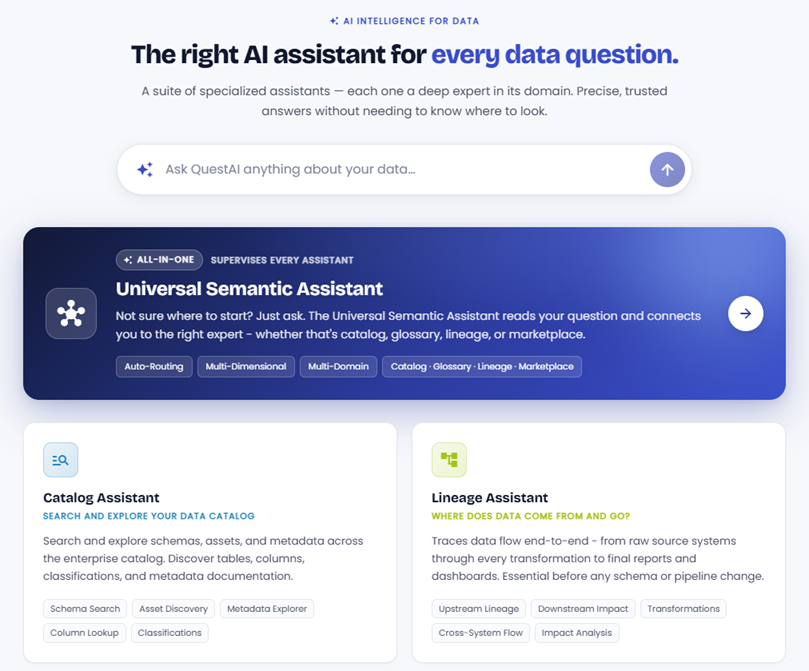
QuestAI eliminates manual searches and documentation deep dives, making data governance accessible to every stakeholder, regardless of technical background.
Key capabilities:
-
Specialized Domain Assistants
-
Intelligent Routing via Universal Semantic Assistant
-
AI-Powered Metadata Enrichment
-
Governed AI adoption
For more information, refer to the QuestAI topic.
Policy Manager
Policy Manager is a new AI‑driven module that enables you to efficiently create, manage, and enforce data governance policies.
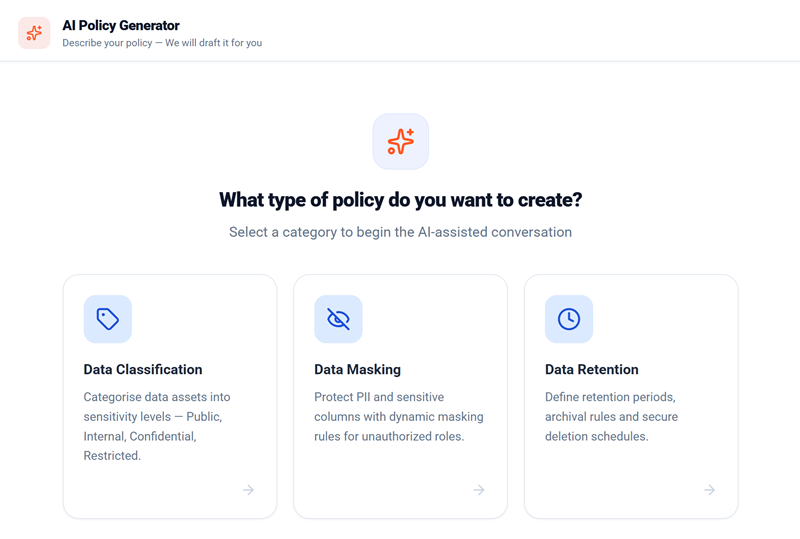
Business users and data stewards can create policies using AI, automatically generate enforcement rules and SQL scripts, and operationalize policies across platforms. The module provides centralized views for policies and associated rules.
Key Capabilities:
-
AI-Powered Policy Creation
-
Automated Rule Generation
-
Policy Enforcement
For more information, refer to the Policy Manager topic.
Enterprise Tag Groups
The Enterprise Tags module has been renamed to Enterprise Tag Groups, introducing governance-driven tagging capabilities that transform metadata organization from a flat, inconsistent model into a structured, controlled classification framework. This enables better consistency, control, and discoverability of metadata.
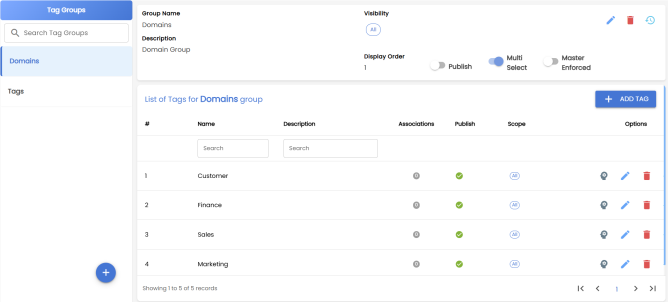
Key Capabilities:
-
Tag Grouping and Organization
-
Tag Creation within Groups
-
Multi-Select Control
-
Master Enforcement
-
Visibility Configuration
-
Tag Lineage and Mind Map Visualization
-
Administration and Governance Controls
For more information, refer to the Enterprise Tag Groups topic.